Phillip S. Jarvis
What 50 Years of Career and Workforce
Development Leadership Have Taught Me
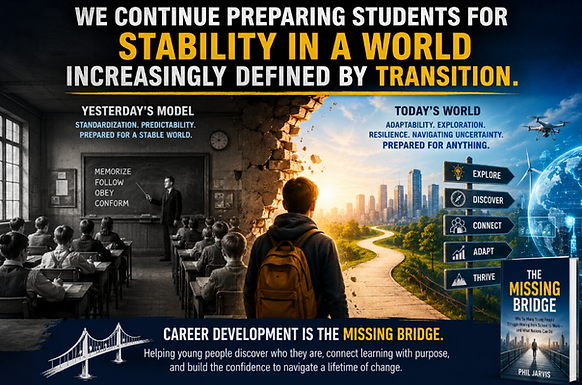
We continue preparing students for stability in a world increasingly defined by transition.
Many of our school systems were designed for the Industrial Age, a time when careers were often linear, employers expected predictability, and workers could reasonably anticipate spending decades in the same occupation or organization. That world has largely disappeared. Today's students will likely navigate multiple careers, changing industries, rapid technological disruption, artificial intelligence, economic uncertainty, and occupations that don't yet exist. Success will depend less on memorizing information and more on developing the ability to adapt, explore, learn continuously, make informed decisions, and navigate uncertainty with confidence. Yet much of our educational infrastructure still reflects yesterday's assumptions. We continue emphasizing standardization, while the future increasingly rewards curiosity, resilience, career agency, creativity, collaboration, and informed exploration. This is not a criticism of educators. Teachers are working harder than ever within systems they did not design. The challenge is systemic, not individual. The question is no longer whether education should prepare students for work. It is whether we will equip them with the knowledge, experiences, relationships, and guidance they need to build meaningful, adaptable lives in a rapidly changing world. Career development is the missing bridge. It helps young people discover who they are, understand the opportunities around them, connect learning with purpose, and develop the confidence to navigate a lifetime of change. If we truly want stronger economies, healthier communities, and more fulfilling lives, we need to modernize not only what students learn, but how they prepare for their futures. That may be one of the most important nation-building investments we can make. This theme is explored in my forthcoming book, The Missing Bridge: Why So Many Young People Struggle Moving from School to Work—and What Nations Can Do.